Bruges Day Tours
I’m Serious Day Tour Man AI, your day trip expert. Ask me anything — where to go, how to get there, and what’s actually worth your day.
Basing yourself in Bruges is the connoisseur’s Belgium move. You inherit the most beautiful town in the country at the hours the day-trippers never see — early canals, lamplit evenings — and you hold a day-trip hand most visitors don’t realize exists. The North Sea coast is fifteen minutes away, with the world’s longest tram line running its length. A perfect medieval village sits one canal-side bike ride north. Ghent, the livelier rival, is twenty-five minutes by train. And Flanders Fields is close enough that the 8 p.m. Last Post at Ypres — the ceremony that Brussels-based tours structurally miss — becomes an easy evening rather than a logistical feat.
The trains and the bike do all the work here. Nothing on this list requires a car, and half of it barely requires planning.
Here’s what’s worth a day, with real times and honest trade-offs.

Popular Day Trips
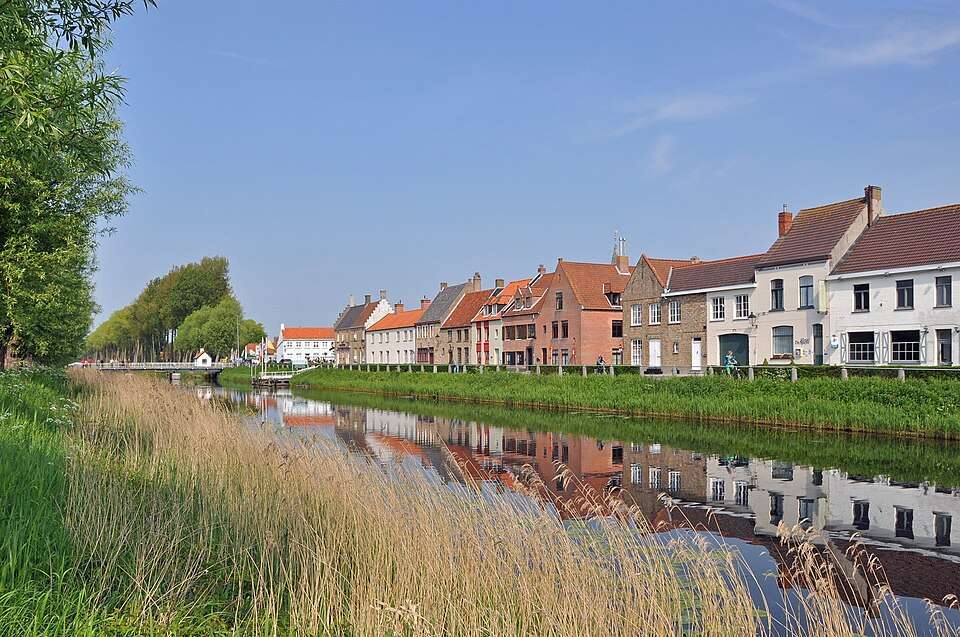
Damme — The Canal Ride North
The signature Bruges trip, and it’s seven flat kilometers. Rent a bike and follow the poplar-lined Damse Vaart canal to Damme, the medieval port that was Bruges’ outer harbor before the sea silted away and left both towns preserved in amber. The village is an hour’s stroll: a tilting Gothic church tower you can climb, a town hall wildly out of scale with the four streets around it — the wealth left, the architecture stayed — and long-lunch restaurants that have made Damme a dot on the Flemish gastronomy map.
The alternative transit is the Lamme Goedzak, the nostalgic paddle-wheeler that plies the canal seasonally. Bike out, boat back is the choreography. Half a day, zero logistics, and the ride itself — windmill, poplars, canal — is the postcard. Take this one on your gentlest day.
Read the full Damme day-trip page.
The Coast & the Kusttram
Fifteen minutes by train puts you at Ostend, where a transit curiosity becomes an itinerary. The Kusttram — the longest tram line in the world — runs the entire 67-kilometer Belgian coast, stop by stop, which turns the seaside into a hop-on tasting menu.
The stops that matter: Ostend itself, the “queen of the seaside resorts,” with its jaunty promenade, the Mercator tall ship, and shrimp croquettes as the civic dish. De Haan, the Belle Époque village where the tram stop is a listed monument and Einstein waited out 1933 — its villa quarter is the most intact prewar seaside architecture in Belgium. And Knokke at the top end, for galleries, polish, and the tidal bird flats of the Zwin nature reserve.
The calendar: this coast is a summer-and-shoulder creature. In winter it turns bracing and atmospheric, which some visitors love and others should be warned about. Mussels on a promenade terrace are the season’s contract.
Ypres & Flanders Fields — The Local Advantage
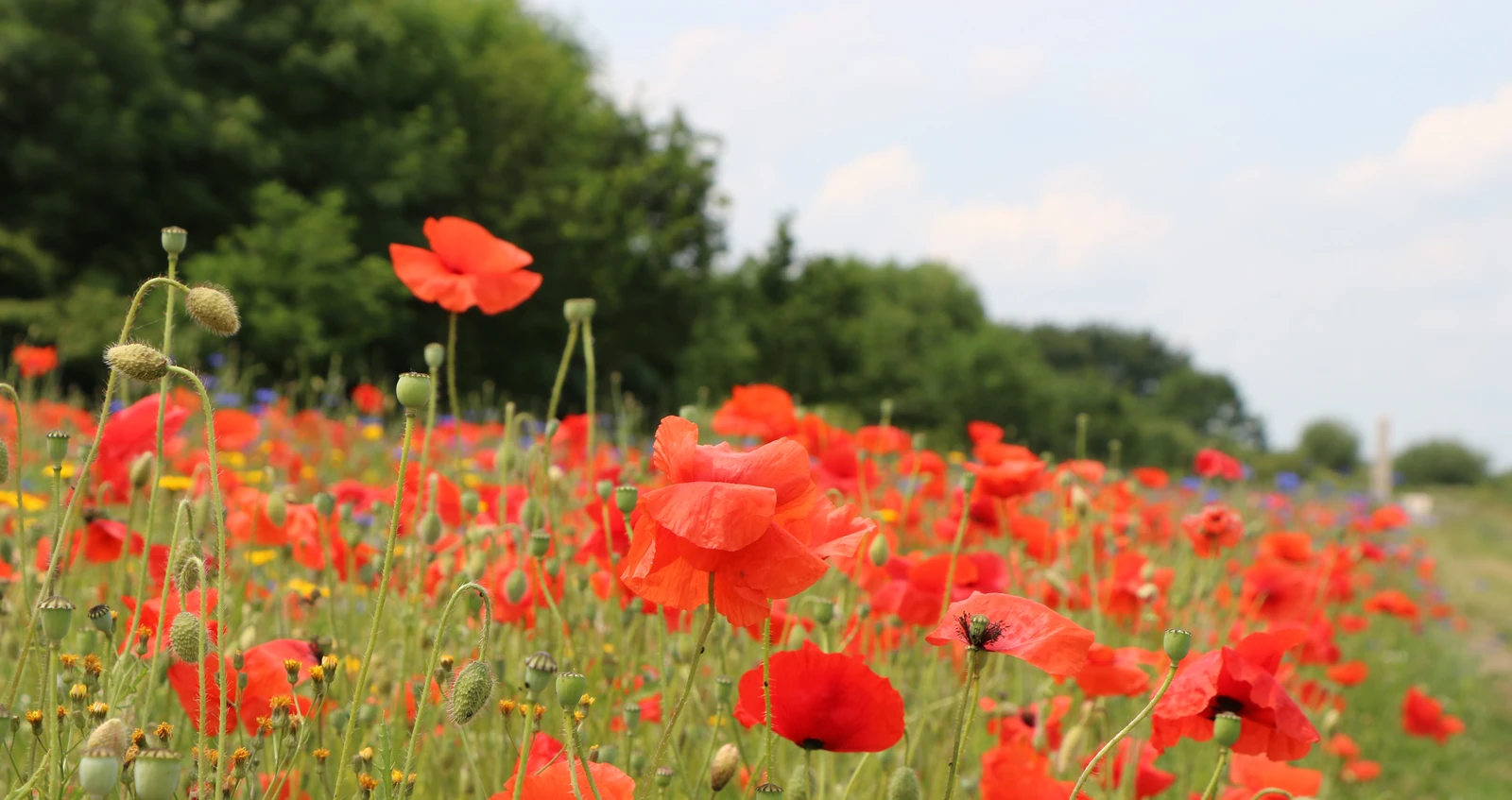
An hour southwest — meaningfully closer than from Brussels — and the proximity changes what’s possible. The Last Post under the Menin Gate has been sounded at 8 p.m. every evening since 1928, and from Bruges it fits the day naturally, either with a tour that stays for it or a self-drive that lingers.
The day itself holds the Salient’s essential ground: Tyne Cot and its 12,000 headstones, the In Flanders Fields Museum in the rebuilt Cloth Hall, Essex Farm’s dressing-station bunkers where the poem was written, and Langemark, the dark German counterpart. This is heavy ground and must be treated that way: go with a guide who tells it with precision, pair it with nothing cheerful, and stay for the bugles. From Bruges, uniquely, that last part requires no sacrifice.
Read the full Ypres day-trip page.
Ghent — Twenty-Five Minutes to the Rival
The Bruges-or-Ghent debate reads differently from inside Bruges: you’ve already taken the beauty, so take the life too. Ghent is twenty-five minutes by direct train, and its strengths are precisely what Bruges trades away — a working university city’s evenings, Belgium’s best beer-bar density, sanctioned street art, and the Mystic Lamb, the van Eycks’ altarpiece and art history’s most-stolen object, luminously restored in St Bavo’s Cathedral.
The Gravensteen castle audio tour is the rare one that is funny. Go in the afternoon, stay into the evening, and ride the late train home to your quiet canals. It’s the best both-worlds day in Belgium.
Brussels & Antwerp — The City Reaches
Both an hour away by direct train, and both worth a straight summary. Brussels: the Grand Place (see it twice — daylight and floodlit), the Magritte Museum, the beer-café curriculum, and the frites-waffle-praline consumption science. Skip it if grand squares and museums aren’t your trip; essential if they are. Antwerp: the stronger single day for most people — Rubens at the source, the diamond quarter, the Plantin-Moretus printing house (a UNESCO-listed 16th-century publishing empire preserved intact), and a railway station that counts as a sight in itself.
From Bruges, either works as the big-city palate cleanser after days of canals. If you’re choosing one, Antwerp wins by a nose.
The Belfry, the Beer Pipeline & the Town Itself
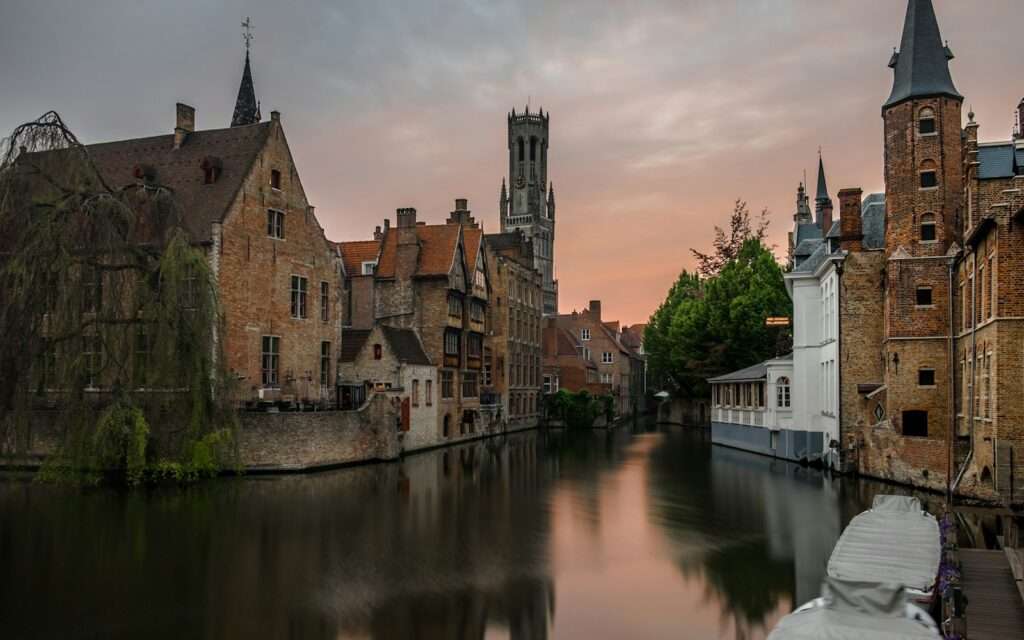
Bruges as a base gets its own program, run on the day-tripper-avoidance clock. The rhythm rule first: the center fills with coach tours from roughly 11 to 5. So climb the Belfry’s 366 steps at opening (timed tickets now manage the queue), walk the canals before 9, and reclaim the Markt after dinner, when the floodlit gables perform for almost no one.
The art essentials: the Church of Our Lady’s Michelangelo — the Madonna the town bought new in 1514, looted twice and recovered twice, the second theft told in The Monuments Men — and the Groeninge Museum’s Flemish Primitives, anchored by van Eyck’s Madonna with Canon van der Paele. The beguinage and the Minnewater supply the quiet.
The local specifics: the De Halve Maan brewery tour ends on a rooftop with a beer and the town’s best piece of trivia — the brewery pumps its beer through a three-kilometer underground pipeline to its bottling plant, built in 2016 and partly crowd-funded by citizens who were paid in beer for life. 2be’s beer wall and the connoisseur cafés (‘t Brugs Beertje, a shrine of 300 bottles) cover the tasting. Chocolate is a working craft here — The Chocolate Line’s Dominique Persoone is the mad-scientist end of it — and lace, the town’s old economy, survives at the Kantcentrum, where demonstrations still happen with bobbins flying. The frietmuseum, the world’s only museum of the fry, is exactly as unnecessary and enjoyable as it sounds. And take the one boat ride, yes, despite the queues: the canal level is the painters’ angle, and it remains correct.
Frequently Asked Questions
What’s the best easy day trip from Bruges?
Damme — a flat 7 km canal-side bike ride to a preserved medieval village, with the seasonal paddle-steamer as the return leg. Half a day, no logistics, all postcard.
Can you visit the Belgian coast from Bruges?
Fifteen minutes by train to Ostend, then the Kusttram — the world’s longest tram line — hops the whole coast: De Haan’s Belle Époque villas, Knokke’s galleries, shrimp croquettes throughout. Summer and shoulder season are its months.
Is Ypres easier from Bruges than Brussels?
Yes — about an hour, close enough that staying for the 8 p.m. Last Post at the Menin Gate requires no heroics. Build the Flanders Fields day around being there for it.
Is Ghent worth visiting if you’re staying in Bruges?
Ideal — 25 minutes by train to the livelier rival: the Mystic Lamb, the beer bars, the student evenings. Afternoon-into-evening is the right shape, with the late train home.
How do you avoid the crowds in Bruges itself?
Live opposite the coaches: canals and Belfry before 9, quiet quarters (Sint-Anna, the beguinage) at midday, and the floodlit Markt after dinner. Staying overnight is the whole advantage — use its hours.